|
|
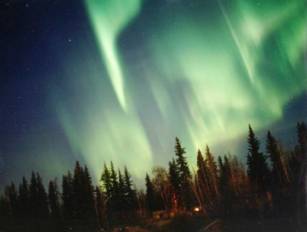
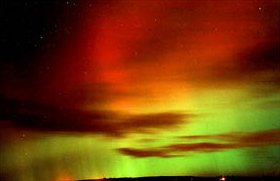
As mushers race the clock trying to win the Iditarod, they take breaks along the way to, usually, either sleep, eat, or for other reasons in the freezing Alaskan wilderness all alone, not what someone might think as utopia. On special nights, though, mushers and their team get a natural reward for trying to survive in the savage northern world. Colorful rays of light fill the sky, beginning in every direction. Some call it nature’s own light show, better known as the northern lights or the aurora borealis.
The northern lights is just one of Mother Nature’s wonders that can be seen in the dark night sky in the northern hemisphere, near the North Pole. Caused by a solar wind, which are high-energy atomic particles emitted from sunspots that head for Earth and other planets, this phenomenon’s journey into Earth begins as the Earth’s magnetic field captures some of the particles. Its electrons and protons go through the magnetosphere and break into the lower Van Allen radiation belt, overloading it. Then, the excess protons and electrons disperse into the atmosphere and head toward the north and south magnetic poles. Because of their speed, they light up the sky as they move, and when they collide with the oxygen and nitrogen in the atmosphere, some energy transforms into light, causing the aurora or light.
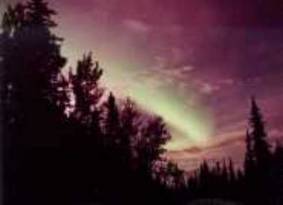
The aurora comes in many different colors, depending whether the oxygen or nitrogen molecule is neutral or charged and on the energy of the particle, from the sun, that hits it. For example, atomic oxygen causes greenish-white light, which is common in aurora displays. The pattern, position, and color of the aurora also depend on the location of the gas molecule the particle collides with during the interaction. Therefore, nitrogen molecules, which are lower in the atmosphere, produce a red light often seen along the bottom edge of an aurora curtain.
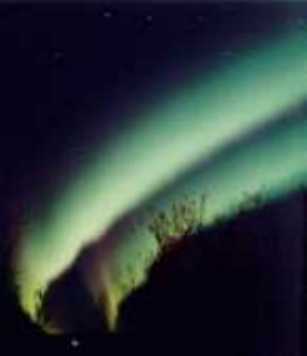
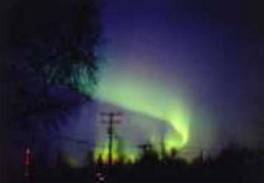
The aurora takes up also many forms and its occurrence once had many forms of reasons. Some include the auroral arch, which is a bright arc lying across the magnetic meridian, flames, curtains, fans, and streamers. What caused these shapes were part of the many legends of Eskimos, the Native Americans of northern North America, and other inhabitants. They include signs of bad omen and fires that their creator has built to show that he still remembers them. In any shape and theory, though, the northern lights are a spectacular sight to everyone, especially for Iditarod racers and their teams.